The Hidden Profit Lever in Grain
For decades, bulk handlers have focused on throughput, logistics, and storage. Increasingly, another variable is shaping outcomes across the network. Grain quality.
Not simply as a laboratory function or compliance checkpoint, but as a driver of margin, pricing accuracy, and operational efficiency. On a smaller scale, variability in quality assessment can be absorbed. Across large networks, it compounds. Differences in how grain is measured, classified, and interpreted create inefficiencies that are difficult to detect and harder to recover.
Results can differ between operators, between sites, and across time. Laboratory workflows can delay decisions, while inconsistencies often lead to disputes, rechecks, and rework. Individually, these issues are manageable. At network scale, they become material.
Even relatively small differences in grading outcomes, sometimes varying by several dollars per tonne depending on commodity and market conditions, can have a significant cumulative impact when applied across total throughput. The industry has often treated this as a measurement problem. In practice, the underlying issue is consistency.
The challenge is not whether grain quality can be assessed, but whether it can be assessed consistently across the entire network. Without that consistency, data becomes fragmented. Pricing decisions weaken, blending becomes less precise, and confidence in outcomes begins to erode.
When quality is standardised, its role changes. Assessment becomes objective rather than operator-dependent. Results are consistent across locations. Data is available in real time and supported by an auditable record. The focus shifts from interpreting variability to acting on reliable information.
Operationally, this can improve blending decisions, limit rework, and support higher throughput by removing bottlenecks in testing and decision-making. This is why some operators are beginning to think about quality differently. Rather than treating it as a point-in-time activity, it becomes a connected data layer spanning receival, storage, processing, and export.
In this model, quality becomes part of the infrastructure of the network: a consistent standard, a unified dataset, and a reliable basis for decision-making throughout the grain's lifecycle. Historically, this level of consistency has been difficult to achieve. Manual inspection introduces subjectivity. Sampling limits visibility. Laboratory processes introduce delay.
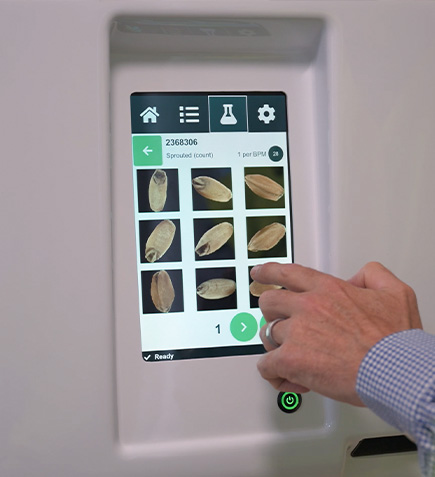
Automated, AI-driven visual analysis is beginning to change that. By assessing individual kernels at high speed and applying consistent classification standards, these systems aim to reduce variability and produce results that are immediate, defensible, and scalable.
At network scale, even incremental improvements in consistency can create meaningful commercial impact. Importantly, these gains are not dependent on increasing volume. They come from reducing inefficiency.
Logistics, storage, and market access will remain important. But a new layer of advantage is emerging in how effectively operators can standardise and apply quality data across their networks.
For operators working at scale, this is not a marginal consideration. It is one of the clearest opportunities to improve performance without changing the volume moving through the system.